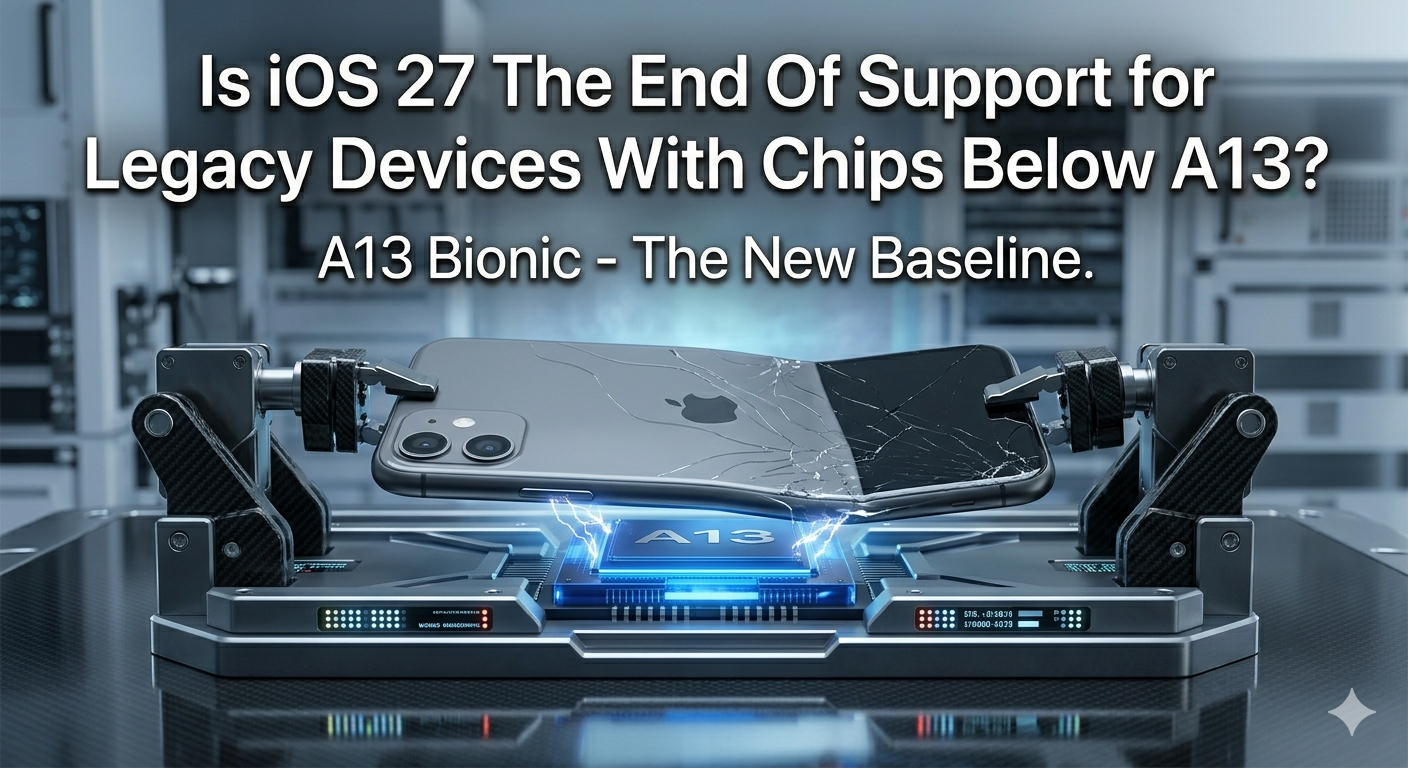
Is iOS 27 The End Of Support for Legacy Devices With Chips Below A13?
By guide4mac.com | April 19, 2026
As the June WWDC 2026 unveiling approaches, the question on every budget-conscious user’s mind is: Is my iPhone still supported? (well, mine as well as I still have an iPhone 11 besides my 14 Pro).
Current supply chain reports and software analysts indicate that iOS 27 will likely draw a hard line at the A13 Bionic chip. This means the iPhone 11 series and the iPhone SE (2nd Generation) are officially in the “uncertainty zone.”
While Apple has a history of supporting devices for 6-7 years, the intense processing requirements of “Apple Intelligence” are forcing the company’s hand. Sources suggest that while the A13 (which has 4GB of RAM) could technically run a stripped-down version of iOS 27, it may not be able to handle the new “On-Screen Awareness” features.
Verified Compatibility Rumors
Based on the most reputable leaks, the following support tiers are expected:
- Confirmed Support: iPhone 12 series and newer. The iPhone 12’s 5nm architecture and improved Neural Engine are reportedly the baseline for iOS 27’s performance-focused code.
- The “Legacy” Cutoff: The iPhone XR, XS, and XS Max (A12 chip) are widely expected to lose support entirely with the move to iOS 27. These devices will remain on iOS 26, receiving only critical security patches.
- The A13 Gamble: There are conflicting reports regarding the iPhone 11. Some insiders suggest Apple will grant it one final “Performance-Only” update without the new AI features, while others believe Apple will retire the A13 chip to streamline the OS for the upcoming 2nm hardware.
Why the Cutoff?
The primary reason for dropping older chips isn’t just speed. It’s RAM and NPU (Neural Processing Unit) capacity. iOS 27’s new “Visual Intelligence” (reading nutrition labels and auto-filling contact info from photos) requires a level of on-device processing that the A12 and early A13 chips simply cannot sustain without overheating.
The Verdict: If you are holding onto an iPhone 11 or older, 2026 is likely the year your device enters “Legacy” status, receiving security updates but missing out on the future of the iOS ecosystem. Maybe you could think about making some economies for a newer iPhone, if the WWDC unveils that these rumours are true.



0 Comments